


“I advanced, fearing that I’d be forgotten, crying out from fear, hunger, and pain…include me here…I too am a god. Take pity, at least!”
—Benjamin Fondane
Poet, essayist, philosopher, and filmmaker Benjamin Fondane is one of those rare, volcanic figures of 20th-century literature, known, unfortunately, to very few people today.
Born in Romania (1898), he wrote in both Romanian and French, eventually settling in Paris in the 1920s, where he became a prominent presence among the avant-garde, yet never joining its circles. He was a wanderer, a misfit, a Romanian Jew living in French exile who embodied the “outsider” stance with heart-wrenching literalness.
What’s fascinating and yet tragic about Fondane is that he wrote some of his most outstanding poetry while hiding from the Nazis during WW2. After France fell in 1940, Fondane (as a stateless Jew) was arrested several times but released thanks to interventions from French intellectual friends.
Instead of fleeing to safety (he had a visa for Argentina), he refused to abandon his sick sister and brother-in-law. During the years in hiding, he wrote his masterpiece cycle Le Mal des fantômes (1944), including the shattering sequence “Exode” and his famous poem “Préface en prose.”
In these final years, Fondane wrote with a prescient awareness that he would die at the hands of the Nazis. Still, he didn’t fear death, and he wrote without despair. His prose is laced with a furious metaphysical affirmation of existence despite his harrowing circumstances.
His last poems are dated literally weeks before his final arrest. On 30 May 1944, the Gestapo arrested him, and upon arrival at Auschwitz in early June 1944, because he was over 45 and no longer considered fit for work, he was selected for immediate gassing—just weeks before liberation.
Fondane was a poet who lived the 20th-century catastrophe with a fierce intensity and answered it with an uncompromising cry of metaphysical revolt — right up to the threshold of the gas chamber.
The following is one of his last poems, “Préface en prose” (Preface in Prose). It’s a work of poetic defiance, a confessional manifesto written in the face of capture and extermination.
I hope you enjoy it.
Preface in Prose
It is to you I speak, antipodal men,
I speak man to man,
with the little in me of man that remains,
with the scrap of voice left in my throat,
my blood lies upon the roads, let it not, let it
not cry out for vengeance!
The death-note is sounded, the beasts hunted down,
let me speak to you with these very words
that have been our share-
few intelligible ones remain.
A day will come, surely, of thirst appeased,
we will be beyond memory, death
will have finished the works of hate,
I will be a clump of nettles beneath your feet,
-ah, then, know that I had a face
like you. A mouth that prayed, like you.
When a bit of dust, or a dream,
entered my eye, this eye shed its drop of salt. And when
a cruel thorn raked my skin
the blood flowed red as your own!
Yes, exactly like you I was cruel, I
yearned for tenderness, for power,
for gold, for pleasure and pain.
Like you I was mean and anguished,
solid in peacetime, drunk in victory,
and staggering, haggard, in the hour of failure.
Yes, I was a man like other men,
nourished on bread, on dreams, on despair. Oh, yes,
I loved, I wept, I hated, I suffered,
I bought flowers and did not always
pay my rent. Sundays I went to the country
to cast for unreal fish under the eye of God,
I bathed in the river
that sang among the rushes and I ate fried potatoes
in the evening. And afterwards, I came back for bedtime
tired, my heart weary and full of loneliness,
full of pity for myself,
full of pity for man,
searching, searching vainly upon a woman's belly
for that impossible peace we lost
some time ago, in a great orchard where,
flowering, at the center,
is the tree of life.
Like you I read all the papers, all the bestsellers,
and I have understood nothing of the world
and I have understood nothing of man,
though it often happened that I affirmed
the contrary.
And when death, when death came, maybe
I pretended to know what it was, but now truly
I can tell you at this hour,
it has fully entered my astonished eyes,
astonished to understand so little-
have you understood more than I?
And yet, no!
I was not a man like you.
You were not born on the roads,
no one threw your little ones like blind kittens
into the sewer,
you did not wander from city to city
hunted by the police,
you did not know the disasters of daybreak,
the cattle cars
and the bitter sob of abasement,
accused of a wrong you did not do,
of a murder still without a cadaver,
changing your name and your face,
so as not to bear a jeered-at name,
a face that has served for all the world
as a spittoon.
A day will come, no doubt, when this poem
will find itself before your eyes. It asks
nothing! Forget it, forget it! It is nothing
but a scream, that cannot fit in a perfect
poem. Have I even time to finish it?
But when you trample on this bunch of nettles
that had been me, in another century,
in a history that you will have canceled,
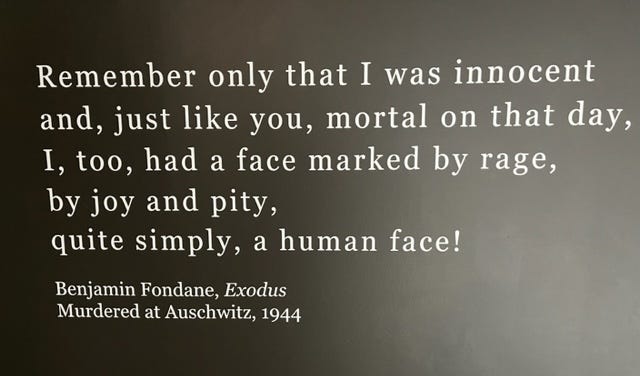
remember only that I was innocent
and that, like all of you, mortals of this day,
I had, I too had a face marked
by rage, by pity and joy,
an ordinary human face!