

The older we get, the more the ghosts crowd and claim us. Death does not deter the dead from living on within us and around us. We are under their spell.
The world becomes irrevocably haunted.
— Nick Tosches
Every now and then, I like to stroll into an old cemetery and just sit for a few moments in the bewildering gloom of a random afternoon.
It’s strange, I know, but being there alone feels like being in a little sanctuary far from the suicidal world that we’ve created for ourselves. The birds, the subtle hum of the afternoon, the dead flowers scattered around weathered gravestones — just taking it all in.
Being fully there and pondering the impermanence of it all, the brevity of breath, death, death, death—to feel it deeply, to let it quiver, to be completely frightened to the core by its mystery. That’s a life-affirming perspective.
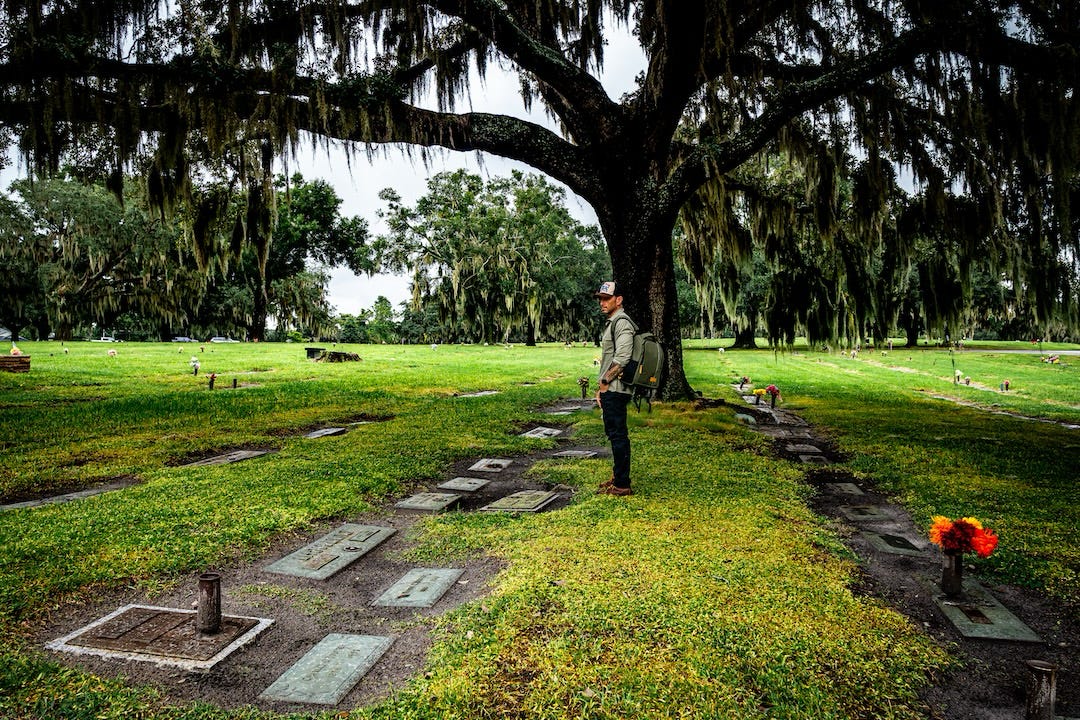
I’m standing at ease in the green grass with rotting bones beneath my feet — bones that were once draped with skin, hair, organs, and blood vessels — bones that were once people who suffered, loved, and had secrets, and jobs, and children, and strong beliefs only to forever vanish from the pulse of life. Mostly forgotten.
Like us, they worried about things that never happened. They postponed adventures, chased ambitions, fell in love, suffered disappointments, and imagined there would always be more time. And now, beneath the earth, they offer us this little reminder: You are alive. Your time is limited. Don’t squander the sublime light.
It’s a conscious elevating experience every time. A midday meditation that forces you into a state of gratefulness for the modest little miracles around you — the ant, the dandelion on the sidewalk, the mole on your neck, the fallen leaves under the mighty oak.
“Death's stamp gives value to the coin of life; making it possible to buy with life what is truly precious.”
—Rabindranath Tagore
When you wander alone among the dead and read the epitaphs etched in decrepit gravestones, all the petty grievances, manufactured emergencies, trivial ambitions, and anxieties that eat up so much of our waking lives suddenly appear remarkably insignificant.
This is the strange paradox. Sometimes the best place to rediscover the joy of being ALIVE is among the dead. We encounter a truth modern civilization works on and on to conceal: our time here is astonishingly brief, so LIVE intensely, with passion and love, and try not to let the clock devour what’s left of our lives.
If we’re lucky, we’ll come to realize, as Henry Miller did, that “the worst is not death but being blind, blind to the fact that everything about life is in the nature of the miraculous.”
When I was out in the cemetery the other day, I couldn’t help but be reminded of the many great poets of the past who wandered through graveyards to dwell on their mortality. This set the mood for melancholic contemplation, dreadfully reminding them of life's limits and the flesh's ultimate return to the earth.
Over a thousand years ago, the Japanese Poet, Ki no Tsurayuki once wrote these beautiful, haunting words: “When these poets saw the scattered spring blossoms, when they heard leaves falling in the autumn evening, when they saw reflected in their mirrors the snow and the waves of each passing year, when they were stunned into an awareness of the brevity of life by the dew on the grass or foam on the water…they were inspired to write poems.”
The most well-known of the Graveyard Poets was Thomas Gray and his famous Elegy Written in a Country Churchyard (1751). Standing among the graves of ordinary villagers, Gray reflects on forgotten lives, unrealized possibilities, and the leveling power of death. His poem reminds us that worldly fame and ambition mean very little in the face of eternity.
“The paths of glory lead but to the grave.”
Long before his own mysterious death, Edgar Allan Poe regularly walked through the old city burial grounds. He took long strolls through them, sometimes alone, at other times with his wife. Being among the dead helped nourish his unique perspective on love and loss.
"The boundaries which divide Life from Death are at best shadowy and vague."
The great early American poet, Henry Wadsworth Longfellow, was moved to write these memorable words after visiting a Cemetery in Newport, Rhode Island:
The trees are white with dust, that o’er their sleep
      Wave their broad curtains in the south-wind’s breath,
While underneath these leafy tents they keep
      The long, mysterious Exodus of Death
Rainer Maria Rilke, a poet who treated death not merely as life's negation but as something intimately intertwined with existence, once wrote:
“There is death in life, and it astonishes me that we pretend to ignore this: death, whose unforgiving presence we experience with each change we survive because we must learn to die slowly. We must learn to die: That is all of life.”
Perhaps the most life-affirming thing we can do is to acknowledge the shortness of life and to live not in denial but with complete awareness of our imminent death — to keep it as a companion in our front pocket as a reminder of our brief visitation on this amazing planet.
As the great German philosopher Martin Heidegger once said: “If I take death into my life, acknowledge it, and face it squarely, I will free myself from the anxiety of death and the pettiness of life — and only then will I be free to become myself.”
I’d like to end with part of a beautiful poem by Lebanese-American poet Kahlil Gibran.
You would know the secret of death.
    But how shall you find it unless you seek it in the heart of life?
    The owl whose night-bound eyes are blind unto the day cannot unveil the mystery of light.
    If you would indeed behold the spirit of death, open your heart wide unto the body of life.
    For life and death are one, even as the river and the sea are one...

For what is it to die but to stand naked in the wind and to melt into the sun?
    And what is it to cease breathing, but to free the breath from its restless tides, that it may rise and expand and seek God unencumbered?

    Only when you drink from the river of silence shall you indeed sing.
    And when you have reached the mountain top, then you shall begin to climb.
    And when the earth shall claim your limbs, then shall you truly dance.
Thank you so much for reading. My work and research I put into this Substack Page are entirely reader-supported. If you enjoy the content I provide and are not ready to become a paid subscriber, you can simply make a one-time donation here at Buy Me A Coffee. If you can. I appreciate you all following this page. You’ve truly made it into a magical little online community. Thank You.
You can also find me around the internet at the following:
Facebook: https://www.facebook.com/erik.rittenberry
Instagram: https://www.instagram.com/erik_rittenberry/