What is our innocence,
what is our guilt? All are
naked, none is safe.

And whence is courage:
the unanswered question,
the resolute doubt, —
dumbly calling, deafly listening—that
in misfortune, even death,
encourage others
and in its defeat, stirs
the soul to be strong?

He sees deep and is glad, who
accedes to mortality
and in his imprisonment rises
upon himself as
the sea in a chasm, struggling to be
free and unable to be,
in its surrendering
finds its continuing.

So he who strongly feels,
behaves. The very bird,
grown taller as he sings, steels
his form straight up.

Though he is captive,
his mighty singing
says, satisfaction is a lowly
thing, how pure a thing is joy.
This is mortality,
this is eternity.
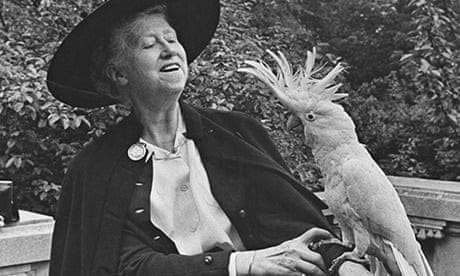
Marianne Moore (1887–1972) was a major American modernist poet celebrated for her precise, witty, and innovative style. Born near St. Louis and raised mainly by her mother, she studied biology at Bryn Mawr College, which sharpened her keen observational eye.
Her poetry is known for its exact language, syllabic meter, intricate descriptions of animals and objects, and the clever incorporation of quotations, often exploring themes of restraint, independence, and the relationship between art and nature. Key works include Observations (1924), featuring poems like “Marriage” and “An Octopus.”
She edited The Dial magazine and later became a beloved cultural figure, winning the Pulitzer Prize, National Book Award, and Bollingen Prize for her Collected Poems in 1951. Moore died in New York City in 1972, leaving behind a legacy of intellectual depth and originality.
If you’ve been enjoying the work and aren’t quite ready to subscribe, but still want to support this Substack page in some way, you can leave a one-time tip through Buy Me a Coffee — if that’s within your reach. Thank you so much for the support.